Xiamen Tmax Battery Equipments Limited was set up as a manufacturer in 1995, dealing with Laboratory equipments, technology, etc. We have total manufacturing facilities of around 2, 000 square meters and more than 100 staff. Owning a group of experie-nced engineers and staffs, we can bring you not only reliable products and technology, but also excellent services and real value you will expect and enjoy.
Mini Sputter Coater: Compact and High-Precision Thin-Film Deposition Equipment
Overview
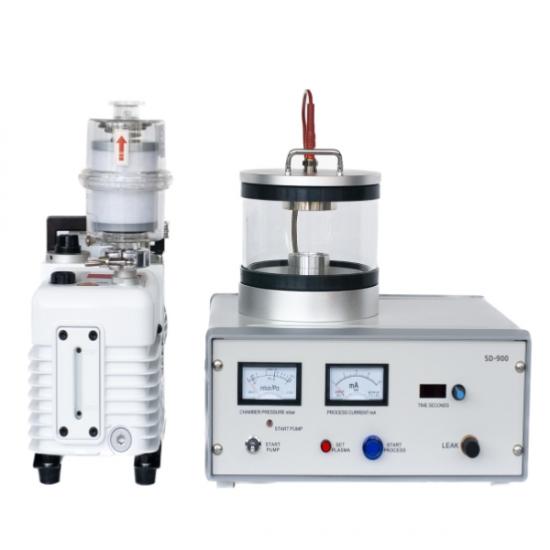
A Mini Sputter Coater is a compact, high-precision vacuum deposition system designed for coating small substrates with thin, uniform films. Based on the physical vapor deposition (PVD) principle, it uses sputtering technology to deposit metals, alloys, or compound materials onto a substrate surface. Mini sputter coaters are particularly suitable for laboratory research, prototype development, and educational applications, where space is limited and high-quality, reproducible coatings are required. Despite its compact size, the mini sputter coater provides precise control over film thickness, uniformity, and adhesion, making it an essential tool for materials science, microscopy, electronics, and surface engineering.
Key Features
Mini sputter coaters are designed for convenience, precision, and reliability. A high-vacuum chamber with efficient pumping systems ensures a clean environment, minimizing contamination and enabling high-purity deposition. Many systems support multiple target materials, allowing flexibility in coating different metals, alloys, or compounds.
The equipment typically features a digital or touchscreen control interface, enabling precise adjustment of sputtering parameters such as power, chamber pressure, deposition time, and gas flow rate. Additional features, such as substrate rotation, multi-sample holders, and quick target replacement, improve coating uniformity and operational efficiency. The compact footprint and user-friendly design make mini sputter coaters ideal for laboratory benches, small-scale research setups, and educational environments.
Working Principle and Coating Process
The mini sputter coating process begins with placing the substrates into the vacuum chamber, which is then evacuated to the desired base pressure. An inert gas, most commonly argon, is introduced into the chamber. Electrical power is applied to the target material, ionizing the gas and forming a plasma.
Positively charged argon ions are accelerated toward the negatively biased target, causing atoms to be ejected from the target surface. These sputtered atoms travel through the vacuum and deposit uniformly onto the substrate, forming a thin, dense, and adherent film. By adjusting parameters such as sputtering power, deposition time, and target-to-substrate distance, the mini sputter coater can produce films ranging from a few nanometers to several hundred nanometers, suitable for high-resolution imaging, material characterization, and prototype fabrication.
Laboratory Sputter Coater
Applications
Mini Sputter Coaters are widely used in research, development, and educational settings. In scanning electron microscopy (SEM), they are essential for coating non-conductive samples with a thin conductive layer, reducing charging effects and improving imaging resolution.
In electronics and microelectronics research, mini sputter coaters are used to deposit conductive layers, electrodes, and interconnects on small components or prototypes. In optics and photonics, they enable thin-film deposition for reflective, anti-reflective, or protective coatings. Other applications include nanotechnology research, thin-film sensor fabrication, materials science experiments, and educational demonstrations in laboratories where compact, precise equipment is needed.
Advantages
The main advantage of a mini sputter coater is its ability to deliver uniform, dense, and adherent coatings on small or delicate substrates. The controlled vacuum environment ensures high-purity deposition, while the compact design allows operation in limited laboratory spaces.
Additional benefits include precise control over deposition parameters, reproducible results across multiple samples, and versatility in handling a wide range of target materials. Mini sputter coaters also offer fast coating cycles, low maintenance requirements, and user-friendly operation, making them ideal for laboratory, educational, and R&D applications.
Conclusion
In summary, the Mini Sputter Coater is a compact, versatile, and precise thin-film deposition system suitable for laboratory research, prototype development, and educational purposes. Its advanced features, accurate process control, and broad range of applications make it an essential tool for SEM sample preparation, materials science experiments, and small-scale thin-film fabrication. By providing high-quality, uniform, and reproducible coatings, the mini sputter coater supports innovation, precision, and efficiency in modern scientific and technological research.